
salmon university saltwater fishing education, john keizer, tom nelson, washington, british columbia, puget sound, pacific northwest salmon and halibut fishing
Silver Horde Tackle
Silver Horde Tackle
Tel: 425-778-2640
Great Lakes Homes Page

Introduction to Fishing Offshore in Depths of Over 200 Feet of Water
By: Jonathan Hemb

Great Lakes fishing has evolved in the past decade and the most significant change in targeting salmon and trout on the Great Lakes has been the exploration of the offshore frontier that exists on these bodies of water. During the 1960s, 70s, 80s and 90s most anglers targeted salmon and trout in depths of under 140 feet of water. However, in the late 1990s and more specifically the early 2000s, anglers have found the need to target fish in depths of over 200 feet of water due to the invasion of the zebra mussels and similar organisms that have made the water much clearer and the fish much spookier than in past decades. Many anglers look at the horizon with fear and trepidation. However, a slight change in attitude can result in coolers full of fish if anglers are patient and know when to target fish in deep water.

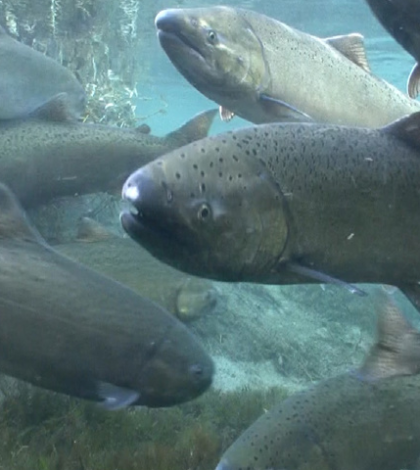
Some anglers may ask what kinds of fish they can expect to find offshore in over 200 feet of water. The answer is simple: Chinook Salmon, Coho Salmon, Rainbow Trout and Lake Trout. Other anglers may ask when they can find those fish in those waters. Again, the answer is simple: winter, spring, summer and late fall. What fish and when depends on water conditions of course, but anglers should not be afraid of probing deep water for fish if their normal hot spots are not producing.

Spring is one of the best times to probe deep water for a mixed bag of salmon and trout on the Great Lakes. The species named above typically spend most of the winter months in deep water where stable water temperatures can be found. Zoo plankton and alewife winter in deep water as well, providing salmon and trout a quick, easy, high protein meal. As the water warms in the spring, alewives move into the shallow water to spawn and the predators follow. If anglers are fishing in mid-May or early June and not finding the water temperatures they prefer and are not marking fish on their sonar, chances are the baitfish and predators are still roaming deep water over 200 feet deep. Lake Trout, King Salmon and Coho Salmon can be found in abundance under these water conditions.

Summer months can also be great times to target salmon and trout in deep water. The most important characteristic of offshore fishing during the summer months is the thermocline, the depth at which the temperature of water drops between 5 and 10 degrees in 5 to 10 feet in the water column. If warm water is present top to bottom in 100 feet of water, active game fish will not be present. However, if the thermocline is present 80 feet down in 220 feet of water, you have a recipe for success. King Salmon and Lake Trout can be targeted below the thermocline and Steelhead can be targeted above it.

Lastly, offshore fishing can also be very productive in the fall months for various species. Steelhead begin their migration toward shore in the fall and can typically be found in the top 50 feet of water while they make their way towards shore. Late-maturing adult King Salmon can also be found over deep water if a thermocline is present and they are not yet ready to spawn. However, immature King Salmon dominate the catch during offshore fall fishing. Two and three year old salmon typically congregate around baitfish and the thermocline at this time of year in deep water.

Articles discussing how to catch these fish will follow. In those articles you will learn in depth rigging techniques and specific tackle to use while targeting these fish that many anglers overlook. An open-mind will be required for anglers who do not believe that salmon and trout can be had by the box-full in these waters. A slight change in attitude towards the horizon can mean full coolers on certain days when near shore fisherman can not get a bite. One last consideration: there is something special about fishing 8, 10, 15 or even 20 miles offshore and loading the cooler. For Great Lakes fisherman, this is something we see on TV during the winter months when we watch ESPN shows highlighting billfish and marlin in the ocean. You too can probe the horizon for big fish out of your port if you follow the articles that will be posted with in-depth, how-to information that is yet to come on all of these topics.