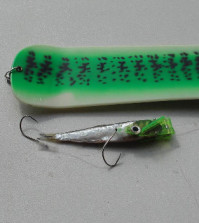

Metal jigs--called slab jigs by many coastal anglers--have been
producing impressive catches of various saltwater species for
decades. British Columbia anglers have been catching salmon on
them for a long time, and about 30 years ago Washington salmon
fishermen began to figure it out, with equally good results. Oregon
anglers eventually caught on, and now jigging is a fairly well-accepted
salmon-fishing technique as far south as the northern California
coast.
It's easy to understand the growth of the jig fishery for salmon.
Most importantly, jigs work! These little slabs of metal are the
approximate size and shape of the herring, anchovies and other
small baitfish on which Chinook, Coho and other Pacific salmon
feed, so if you put a jig in front of a hungry salmon, it's likely
to take it for an easy meal. A couple of metal jigs cost about
the same as three or four dozen herring, but will last a lot longer,
and without the mess or smell of fishing with bait. In areas where
spiny dogfish are a problem, jigs reduce--but don't completely
eliminate--the problem of dealing with pesky sharks.
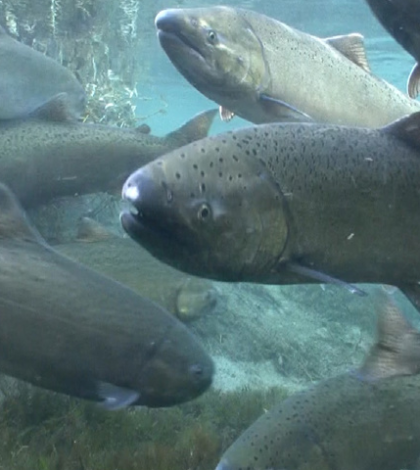
Jigging is especially well-suited to fishing for Chinook salmon,
kings of the Pacific. Chinook often congregate where baitfish
are plentiful and around certain kinds of bottom contours, near-shore
structure or in estuaries before ascending their home streams
to spawn. Locate these king salmon concentrations with your depth
sounder, drop a jig straight down to them and hang on. Kings can
often be teased into striking a jig when other methods fail.
And, in these days of tighter salmon-fishing regulations in many
areas, jigs make catch-and-release fishing a lot easier. Salmon
rarely swallow a jig, so the vast majority of fish are hooked
in the jaw, where they can be easily unhooked and released.
While Pacific salmon, especially Chinook, can be very vulnerable
to a well-fished jig, some anglers have been slow to accept this
relatively new fishing method. Many give it a try or two, fail
to figure the basics of good jigging, and go back to trolling
or mooching. But with a little patience and a day of jigging practice,
anglers who learn the keys to jigging success soon discover that
this is one of the deadliest salmon-fishing techniques of them
all.

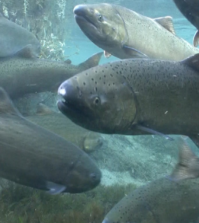
Pictured above, Terry Rudnick with a nice jig
caught King Salmon
First and foremost, the jig has to move. Even with its finely
molded form, realistic finish and lifelike detail, a metal jig
simply hanging there at the end of the line doesn't look like
food to a salmon. Bait, with its natural scent, might draw fish
while it's lying more or less stationary, but a metal jig hanging
vertically in the water looks to a salmon like a, well, a piece
of metal hanging in the water! Move it, though, and it comes to
life, and salmon respond accordingly. Successful jiggers stay
active, constantly twitching the rod tip, lifting and dropping
the rod, reeling and free-spooling line, so that the lure continually
"swims" toward the surface and falls back again, resembling the
spastic gyrations of an injured or disoriented baitfish. A crippled
anchovy, herring or candlefish is an easy mark for a hungry salmon,
and that's what a jig looks like if you keep it moving up and
down through the water column.
A metal jig is at its fish-catching best when it's dropping through
the water, not when it's being lifted toward the surface, so it's
important to let the lure drop as freely as possible. When all
tension is released, metal jigs flatten out into a horizontal
posture, where they vibrate, wobble and dart erratically as they
plummet toward bottom. If you keep tension on the line during
the drop, the lure remains vertical and virtually lifeless, so
it's very important to "throw some slack" on the downward part
of the jigging stroke.
Likewise, allow the jig to free-fall as you're dropping
it to the desired depth. Depending on what your depth sounder is
telling you about the location of feeding fish, you may want to
free-spool the lure all the way down to the desired depth, or, if
the fish are scattered, stop it every six or eight feet, giving
salmon a chance to hit it before continuing the lure's descent.
Whichever way you go, allow the lure to drop rapidly on as slack
a line as you can control.
Since the jig is most active as it's dropping, that's
when most salmon strike. Unfortunately, these slack-line strikes
are among the most difficult in fishing to detect and react to.
What that means is that the jigger has to be alert and ready to
react at all times. If you feel a "tick" on the line as the lure
falls, reel down fast and set the hook hard. If the line goes slack,
indicating the lure isn't falling anymore, reel down fast and set
the hook hard. If the line angle changes...well, you get the picture.
Any of these subtle changes in line tension or direction means a
salmon has intercepted the jig on its way down, and when it realizes
that it has a mouthful of metal instead of a mouthful of meat, it
will start trying to get rid of the bogus meal almost immediately.
If you don't react quickly with a hook-set, you'll be too late.
As for a reel, most jiggers prefer revolving-spool
models over spinning reels because of the line control they afford.
You can quickly clamp down with your thumb on the spool of a revolving-spool
reel when you have to set the hook in a hurry, while with most spinning
reels you have to engage the bail to gain line tension and set the
hook.
Your choice of line also is critical to jigging success.
Just like a limber rod, a stretchy line will absorb lots of energy
and keep you from lifting and dropping the jig effectively. Line
stretch is also a problem in getting a good hook-set in deeper water.
For those reasons, most jiggers prefer today's "super" braids for
much of their salmon fishing. These low-stretch lines let you move
your lure up and down with less effort, set the hook better, and
offer the added advantage of small diameter and therefore less line
drag in the water.
A metal jig will look like the real deal if you're
working it the way you should, but it doesn't hurt to make it smell
real, too, so use scent on your jigs. The jelly or past type scents
work best because they don't wash away like liquid scents do. Besides
adding a "realistic" scent to your jig, scents also help to mask
the human scent, which can be a real fish turn-off.
Your choice of rod, reel and line will play a big
part in your jigging success. Pick a rod that's long and stiff enough
to lift and drop your jig when you lift and drop your arm. It sounds
simple enough, but many anglers start jigging with a rod that's
way too limber, so that when they flail up and down with their arms,
trying to work the jig up and down, the soft rod absorbs all the
energy, flexing and straightening while the jig remains motionless.
A stiffer rod of 7 ½ to 8 feet also gives you more leverage when
the time comes to set the hook on a salmon that may be down there
100 feet or more. Berkley's AIR IM7 model A92-7'9" HB is, as far
as I'm concerned, as close to a perfect salmon-jigging rod as there
is, and it retails for only about $80.
Because even the most stupid salmon realizes its mistake
the second it chomps down on a metal jig and starts immediately
trying to spit out its mistake, needle-sharp hooks are a must. If
you keep hook points sticky-sharp, they'll penetrate that fraction
of an inch that will keep them in contact with fish flesh until
you can get around the burying the barb for keeps. Salmon will use
the weight of the jig to help shake a dull hook in less time than
it takes to tell about it. Carry a good hook file and use it every
time you bring a jig to the surface.
There's no such thing as the perfect metal jig for
all conditions, so carry a selection of sizes and change as the
situation dictates. These lures should be fished pretty much straight
up and down for best results, and you'll need a heavier jig to get
straight down when the wind or current is moving you along at a
good clip. On the other hand, if you go to a smaller diameter line
or as the water calms, you may reach greater depths with lighter
jigs. A lighter lure is generally more active, so you should use
as light a jig as you can get away with, as long as it will reach
the desired depth.
Just as you should go to lighter or heavier jigs depending
on conditions, you should also change your jigging stroke according
to changing conditions. You will, for example, need a longer jigging
stroke to breathe life into a jig that's 150 feet below the surface,
but if you use that same stroke in only 40 feet of water, you'll
probably be moving the lure too much, and may actually be pulling
it away from interested salmon. Shorten the stroke as you fish closer
to the surface, and always be willing to experiment if your "normal"
jigging motion isn't paying off. There are simply times when salmon
want the lure moving faster, slower, farther or not so far.
Happy jigging!
|