
|
Salmon

Salmon are the focus of this site. They
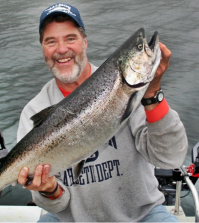
are the most awe-inspiring fish in the sea. When you hook and land a big
salmon, it is one of the best feelings on Earth.
There are five species of Pacific salmon that inhabit our waters.
Chinook: The biggest of the five species is the Chinook, or King
salmon, which in Canada are also called Springs, Tyees (when over 30lbs),
and Smileys (when over 20lbs).
Normal migrating Chinook spend from three to seven years in the sea before
returning to their native river to spawn. Chinook have been reported to
grow as big as 100lbs, but the majority of returning fish are under 30lb.
Returning migratory Chinook are normally caught close to structure, that
is, underwater ledges, shelves and pockets that hold baitfish. If you
start fishing before light, you can fish near the surface, but as soon
as the sun hits the water, you'll want to start presenting your lures
deeper if you're targeting Chinook.
Some hatchery-raised Chinook are
purposely kept in net pens and delayed-released into the saltwater. These
fish never migrate far out to sea, but stay resident to coastal waters.
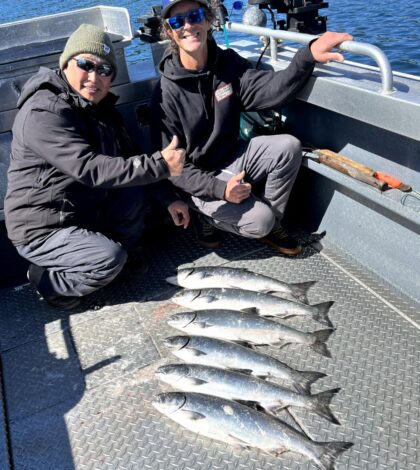
These are the fish we fish for in the winter, and these are called blackmouth.
Blackmouth are normally from five to 15lbs, and a 20lb'er is a trophy.
Blackmouth are normally found right on the bottom, (within 10-15 feet
of the bottom), at around the 120 foot depth.
Coho: The Coho or Silver salmon look similar to Chinook, except
they are normally smaller. An important distinction is that Coho have
white gums at the base of their teeth, while a Chinook's gums are black.
Coho usually live about three years, and grow exceptionally fast in the
third year. They range in size from four to about 20lbs. The Washington
state record coho set this year was around 25lbs.
Returning coho are not as structure-oriented as Chinook, and are normally
found in more open water than Chinook. Coho are caught primarily in the
top 50 feet of water, and close to the edges of tide rips. If you find
bait on the edges of tide rips, and troll a lure near the surface, you
will catch coho.
Sockeye: Sockeye salmon normally live about four or five years.
Sockeye are also called Red salmon. They are usually between 4 to 7 pounds,
but can grow bigger. Sockeye normally only come from river systems that
have freshwater lakes as part of the system. The Lake Washington sockeye
run is a good example of this. Many anglers will tell you that it's hard
to hook sockeye in salt water and impossible to hook them in the fresh
water, but we'll show you that this just isn't true... you can have great
success catching sockeye, and they are, in some opinions, the best tasting
salmon.
Pink: Pink salmon are also known as Humpies. Pinks only live two
years, and are about 4-6 pounds, sometimes larger. Pinks In Puget Sound,
the majority of the pink runs happen every other year on the odd-numbered
years. When the humpies are in, they are easy to catch. They also taste
good, but it's important to clean them immediately and care for them correctly.
Chum: Chum salmon are also known as Dog or Keta salmon. Chum salmon
live three to five years, and are normally 10 to 15 pounds, sometimes
larger. In most Puget Sound waters, the chums are the last fish to return
to the rivers to spawn.
Click here
to see pictures and to find out more about the five species of Pacific
salmon.
For information on how to catch salmon
in the rivers, please check out Steelhead
University.
|
|